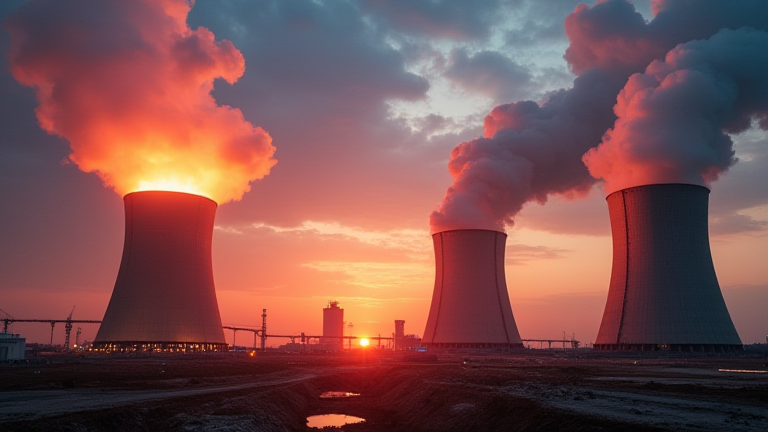
TL;DR: The US-China nuclear fusion race has shifted from academic curiosity to a high-stakes geopolitical and commercial competition, with both nations aiming to secure energy independence and technological supremacy. This new power struggle is driven by massive state-backed investments and private sector innovation, promising to redefine global energy markets and strategic alliances.
Market Analysis: The Trillion-Dollar Opportunity
The global nuclear fusion market is projected to reach over $2 trillion by 2050, driven by the urgent need for clean, limitless energy sources. Unlike traditional renewables, fusion offers baseload power without carbon emissions or long-lived radioactive waste. Currently, the market is characterized by a dual-track approach: government-led research programs and a burgeoning private sector. In the United States, private companies like Commonwealth Fusion Systems and Helion Energy have raised billions in venture capital, signaling investor confidence. Conversely, China’s State-Owned Enterprise (SOE) model channels state funds directly into R&D, creating a parallel but equally aggressive market dynamic. This bifurcation suggests that the first commercial plant will not just be a scientific milestone but a massive export opportunity, potentially disrupting global oil and gas markets.
If you want to dig deeper, check out our guide on 10 Trendy Summer Dresses That Are Actually Worth the Hype.
Strategy Insights: Speed vs. Scale
Strategic differentiation between the two superpowers is evident. The US strategy relies on agile private innovation, leveraging risk capital to accelerate iteration cycles. This approach prioritizes speed to market and commercial viability, often bypassing bureaucratic hurdles. China, however, emphasizes scale and state coordination. By integrating fusion research into its broader national infrastructure plans, China aims for steady, large-scale breakthroughs. Key strategic insights suggest that while the US may lead in novel reactor designs, China may have the advantage in supply chain integration and grid management. Companies must navigate this landscape by forging partnerships that bridge regulatory gaps and securing intellectual property rights early, as patents in plasma physics and high-temperature superconductors will be critical assets.
Case Studies: ITER vs. CRAFT
The International Thermonuclear Experimental Reactor (ITER) in France serves as a baseline for international cooperation, but the US and China are now pursuing independent paths. The US Department of Energy’s CRAFT (CFETR) project, a collaboration with China, highlights the complex interplay between competition and cooperation. While CRAFT aims for a Chinese-built reactor to test ITER technologies, the US is simultaneously pushing the National Ignition Facility (NIF) to achieve sustained fusion. NIF’s recent milestones, achieving fusion energy output exceeding input, validate the tokamak design and boost US confidence. In contrast, China’s EAST reactor has set world records for plasma confinement, demonstrating superior long-term stability. These case studies reveal that while the US excels in peak power achievements, China is optimizing for sustained operation, a critical factor for commercial viability.
FAQ
Q: When will commercial fusion energy be available?
A: Most experts predict the first commercial fusion plants will become operational by the 2030s or 2040s, though this timeline remains subject to technical breakthroughs and regulatory approvals.
Q: How does fusion compare to fission in terms of safety?
A: Fusion is inherently safer than fission because it does not produce a chain reaction that can lead to a meltdown, and it generates minimal long-lived radioactive waste.
Q: What is the biggest barrier to commercialization?
A: The primary barriers are sustaining plasma stability for long durations and developing materials that can withstand extreme temperatures and radiation, which remain significant engineering challenges.
Leave a Reply