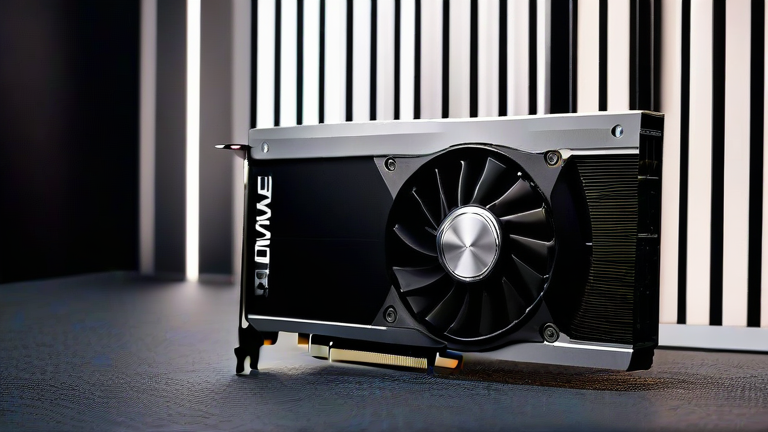
The NVIDIA RTX 4090 remains the ultimate consumer GPU for AI due to its unmatched raw compute performance, massive 24GB of GDDR6X memory, and superior bandwidth capabilities that allow it to handle large language models and generative AI tasks with minimal bottlenecks. It offers the highest performance-per-dollar ratio for serious AI enthusiasts and developers who require professional-grade processing power without the prohibitive cost of enterprise data center hardware.
Unmatched Hardware Specifications
At its core, the RTX 4090 is built on the AD102 GPU, featuring 16,384 CUDA cores and 512 Tensor Cores. These Tensor Cores are specifically optimized for AI workloads, utilizing FP16, BF16, and FP8 data types to accelerate neural network inference and training. The card is equipped with 24GB of GDDR6X memory running on a 384-bit bus interface, delivering a memory bandwidth of approximately 1,008 GB/s. This high bandwidth is critical for AI, as it ensures that data can be moved from memory to the processing units quickly, preventing the memory subsystem from becoming a chokepoint during the execution of complex matrix multiplications required by deep learning models.
Latest Developments in AI Software
The software ecosystem has evolved significantly to leverage the RTX 4090’s potential. Recent updates to NVIDIA’s CUDA toolkit and libraries like cuDNN have introduced more efficient kernels for specific AI frameworks such as PyTorch and TensorFlow. Furthermore, the adoption of quantization techniques, specifically 4-bit and 8-bit quantization via tools like GGUF and EXL2, has allowed users to run much larger language models locally. Previously, running a 70-billion parameter model required multiple GPUs or massive cloud instances. Now, with optimized quantization, the RTX 4090’s 24GB VRAM can accommodate these models, albeit with slower token generation speeds compared to smaller models, it makes local deployment feasible for many developers. The rise of local LLMs, such as Llama 3 and Mistral, has driven demand for hardware that can process tokens per second efficiently, and the 4090 remains the benchmark for this consumer segment.
If you want to dig deeper, check out our guide on 10 Trend Forecasting Tools to Predict Next Season’s Fashion .
Industry Impact and Accessibility
The impact of the RTX 4090 on the AI industry has been profound, democratizing access to high-performance computing. Before this generation of GPUs, serious AI development was largely restricted to large corporations with access to data centers or researchers with significant grants. The 4090 has lowered the barrier to entry, enabling indie developers, startups, and hobbyists to experiment with state-of-the-art AI models on their desktops. This accessibility has fostered a vibrant community of open-source contributors who are pushing the boundaries of what can be achieved with consumer hardware. While the price point of the 4090 is high, its longevity and resale value make it a strategic investment for those serious about AI. It bridges the gap between consumer graphics cards and professional workstation GPUs, offering a level of performance that was previously inaccessible to the average developer. As AI models continue to grow in complexity, the 4090’s headroom ensures it will remain relevant for years, serving as a reliable workhorse for the next wave of AI innovation.
FAQ
Q: Can the RTX 4090 train large language models effectively?
A: It can train smaller models or fine-tune larger ones using mixed precision, but for training massive foundation models from scratch, it is limited by its 24GB VRAM and lack of multi-GPU clustering capabilities compared to data center cards.
Q: Is the RTX 4090 better than professional GPUs like the RTX A6000?
A: For raw inference speed and gaming, the 4090 often outperforms the A6000, but professional cards offer more VRAM (48GB), ECC memory for error correction, and driver stability for long-running enterprise workloads, making them better for specific professional AI tasks.
Q:
Leave a Reply