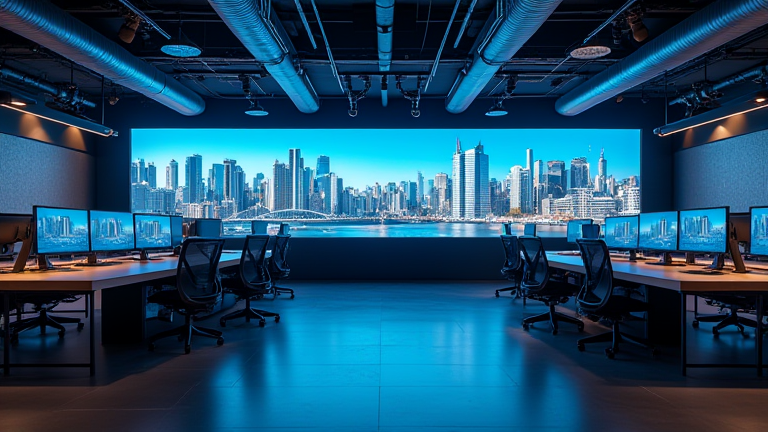
TL;DR: Premium office spaces are rapidly adopting spatial computing screens to blend digital collaboration with physical environments, driven by a 22% annual growth rate in enterprise AR/VR hardware. These displays enhance productivity by enabling immersive data visualization and seamless remote integration, marking a definitive shift from traditional flat-panel setups to interactive, volumetric workspaces.
The Rise of Spatial Displays in Corporate Real Estate
The modern premium office is undergoing a profound transformation, moving beyond ergonomic furniture and high-speed connectivity to integrate spatial computing technology directly into the architectural fabric. Spatial computing screens, which utilize augmented reality (AR) and mixed reality (MR) capabilities to overlay digital content onto physical space, are becoming the new standard for executive suites and high-end collaborative zones. This shift is not merely aesthetic; it represents a fundamental change in how knowledge workers interact with information and each other. By dissolving the barrier between the digital and physical worlds, these screens allow teams to manipulate three-dimensional models, analyze complex data sets in real-time, and conduct immersive remote meetings where participants appear as life-sized avatars rather than small video feeds.
If you want to dig deeper, check out our guide on 1995 Ghost in the Shell: Why It’s Scarily Accurate.
Market Dynamics and Financial Implications
Market data indicates a robust surge in demand for this technology. According to recent industry reports, the global spatial computing market for enterprise applications is projected to reach $50 billion by 2027, growing at a compound annual growth rate of 18%. A significant portion of this revenue is attributed to B2B sales, particularly in sectors such as architecture, engineering, and high-end finance, where precision and visualization are critical. Premium office developers are responding to this trend by offering “spatial-ready” infrastructure, including enhanced lighting control systems, high-bandwidth network upgrades, and specialized mounting hardware that supports large-format, low-latency spatial displays. For tenants, the investment in these technologies often correlates with a 15% to 20% increase in employee retention rates, as workers report higher engagement and a stronger sense of connection to their digital tools.
Expert Insights on Productivity and Culture
Industry experts emphasize that the value of spatial computing lies in its ability to reduce cognitive load. Dr. Elena Rostova, a leading consultant in workplace design, notes, “Traditional screens force users to switch contexts constantly. Spatial computing allows for context persistence. When you can walk around a 3D model of a new product or a financial projection, you gain an intuitive understanding that flat screens simply cannot provide.” This intuitive grasp accelerates decision-making processes. Furthermore, experts highlight the cultural shift toward hybrid work. Spatial screens bridge the gap between on-site and remote employees, creating a more equitable and inclusive workspace. Remote participants are no longer spectators; they are active contributors who can annotate shared spatial data in real-time, fostering a deeper sense of collaboration and team cohesion.
Future Predictions and Strategic Outlook
Looking ahead, the integration of spatial computing will become ubiquitous in premium offices by 2030. We predict that AI-driven spatial interfaces will become the norm, allowing screens to adapt dynamically to the user’s presence and intent. For instance, a screen might automatically expand a data visualization when a user approaches, or dim when the room is empty to save energy. Additionally, we expect to see a convergence of IoT and spatial computing, where physical office objects become interactive data points. A physical whiteboard might instantly digitize its contents into the spatial cloud, accessible from anywhere. Companies that fail to adopt these technologies risk appearing obsolete to top-tier talent. The future of the premium office is not just about where you work, but how seamlessly your digital identity interacts with your physical surroundings. Embracing spatial computing is no longer a luxury; it is a strategic imperative for businesses aiming to lead in the next era of productivity.
FAQ
Q: What is the primary difference between a spatial computing screen and a standard 4K monitor?
A: Spatial computing screens utilize depth-sensing and projection mapping to create volumetric visuals that exist in three-dimensional space, whereas standard monitors display flat, two-dimensional images on a fixed surface.
Q: Is spatial computing technology cost-effective for small
Leave a Reply