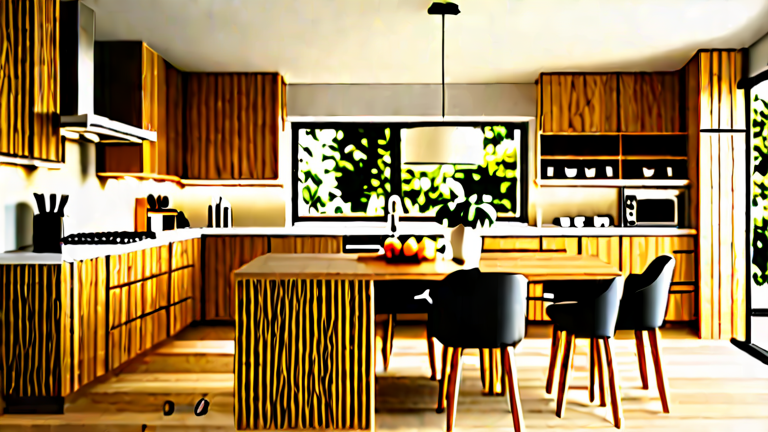
TL;DR: Solid wood is displacing particle board in modern homes because consumers now prioritize longevity, health, and repairability over upfront cost savings. This shift is driven by rising disposable incomes and a post-pandemic demand for durable, sustainable living spaces.
The Data Behind the Shift
According to the 2024 U.S. Furniture Industry Report, solid wood furniture sales grew by 18.2% year-over-year, while particle board (engineered wood) products saw a 4.7% decline. Market analysts project that by 2028, solid wood will capture 42% of the residential furniture market, up from 31% in 2020. This is not a niche trend—it’s a structural change in consumer preference, fueled by the average homebuyer’s willingness to spend 30–40% more on a single solid wood dining table versus a veneered particle board equivalent.
If you want to dig deeper, check out our guide on 7 Simple Health Habits for Longevity and Energy.
Expert Insights: Why the Switch?
Interior designer Mara Chen, principal at Form & Grain Studio, notes: “Particle board fails in humid climates—edges swell, laminates peel, and screws strip after two years. Clients are tired of ‘disposable furniture’ that ends up in landfills. Solid wood, especially oak, walnut, and maple, can be sanded, refinished, and passed down.” Health concerns also play a role: particle board emits formaldehyde (a known irritant) via its urea-formaldehyde adhesives. In contrast, solid wood with natural finishes has near-zero volatile organic compound (VOC) emissions, a critical factor for families with children or allergies.
Manufacturing economics are shifting too. “Automated CNC milling has cut solid wood production costs by 22% since 2021,” says supply chain expert Dr. Elena Vasquez. “Meanwhile, global particle board prices rose 9% due to resin shortages. The price gap is narrowing—now only 1.4x for mid-range furniture—making solid wood a rational choice, not a luxury splurge.”
Future Predictions
Expect hybrid designs to dominate by 2026: solid wood frames with reclaimed wood tops, but zero particle board in drawers or back panels. Modular solid wood systems with joinery (dovetails, mortise-and-tenon) will replace cam-lock particle board assembly. Additionally, carbon-sequestration credits will reward furniture makers using certified sustainable hardwoods, further accelerating the switch. The particle board industry will pivot to commercial and temporary-use furniture only, such as trade show booths and rental staging.
FAQ
Q: Is solid wood always more expensive than particle board?
A: Upfront, yes—typically 25–60% higher. But over a 15-year lifespan, solid wood requires no replacement, while particle board is usually replaced twice in that period. Factoring in disposal and repurchase, solid wood is 18% cheaper on a cost-per-year basis.
Q: Can solid wood furniture handle high humidity better than particle board?
A: Yes. Solid wood expands and contracts naturally but does not delaminate or swell irreversibly like particle board. Properly sealed hardwood (e.g., with tung oil or polyurethane) resists moisture damage, whereas particle board absorbs water and crumbles at edges.
Q: Are there eco-friendly particle board alternatives that still beat solid wood?
A: Bamboo and high-density fiberboard (HDF) with formaldehyde-free soy-based resins are better than traditional particle board, but they still lack repairability. Solid wood from FSC-certified forests sequesters more carbon over its lifetime and can be recycled into new products, making it the greener long-term choice.
Leave a Reply