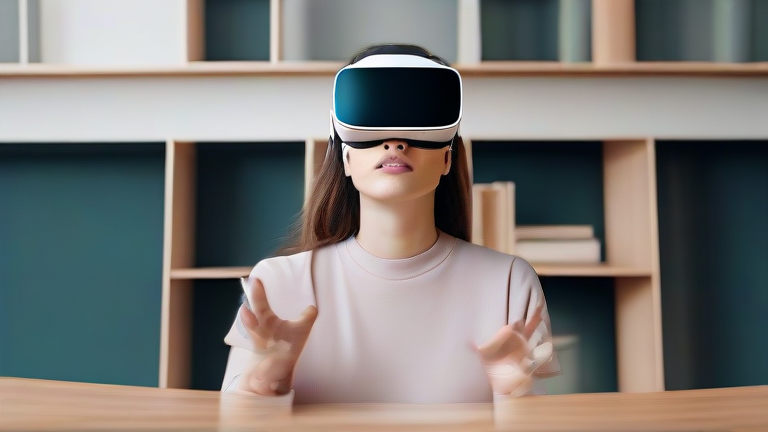
VR Education Replaces Textbooks: The Future of Learning
The traditional classroom experience is undergoing a seismic shift. For decades, students have relied on heavy, static textbooks that fail to capture the dynamic nature of modern scientific and historical concepts. Today, Virtual Reality (VR) education emerges not just as a novelty, but as a revolutionary tool that actively replaces physical textbooks. This technology transforms passive reading into immersive exploration, offering a depth of understanding that paper simply cannot provide.
Imagine walking through the streets of ancient Rome, observing the architectural marvels firsthand, rather than looking at black-and-white photos in a chapter. This is the core promise of VR learning. The primary feature highlight is interactivity. Students can manipulate 3D models of human organs in biology class or conduct virtual chemistry experiments without the risk of hazardous materials. This hands-on approach significantly boosts retention rates, as learners engage multiple senses simultaneously. Furthermore, accessibility is improved; a single device can house thousands of textbooks, reducing physical burden and ensuring that updated content is always available with a simple software update.
If you want to dig deeper, check out our guide on Quantum Computing Hits Commercial Error Correction Milestone.

When compared to traditional methods, the advantages become stark. Textbooks are linear and passive; you read, you absorb, you forget. VR is non-linear and active. You explore, you interact, you remember. While initial setup costs for VR headsets are higher than buying a single book, the long-term savings on reprinting outdated materials and the exponential improvement in student engagement make it a financially viable investment for schools. Critics often cite motion sickness or isolation, but modern hardware has largely mitigated these issues, and collaborative VR environments now allow students to learn together in shared virtual spaces, fostering social interaction alongside academic growth.
However, technology alone is not a magic wand. Successful integration requires proper teacher training and a balanced curriculum that combines digital immersion with critical discussion. The goal is not to eliminate human connection, but to enhance the tools we use to facilitate it. As we stand on the brink of this educational revolution, institutions must decide whether to cling to the past or embrace the future. The evidence is clear: immersive learning leads to deeper comprehension and higher enthusiasm.
Are you ready to transform your learning experience? Do not let outdated methods hold back your potential.
Leave a Reply