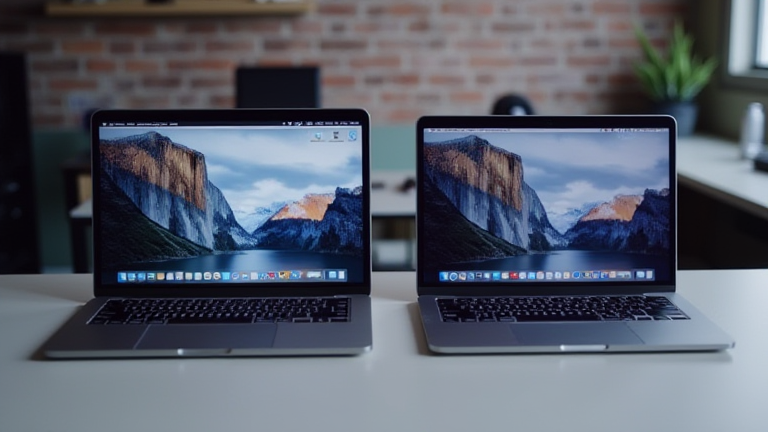
TL;DR: The M3 chip offers significant gains in graphics performance and AI capabilities, making it the superior choice for content creators and developers. However, if your workflow relies primarily on basic productivity tasks and you already own an M2 device, the M2 remains a highly capable and cost-effective option.
The Architectural Leap
Apple’s transition from the M2 to the M3 represents a pivotal moment in consumer silicon design. While the M2 introduced a refined 5-nanometer process, the M3 utilizes a more advanced 3-nanometer architecture. This shift is not merely a marketing term for smaller transistors; it enables higher transistor density, which directly translates to improved power efficiency and higher performance ceilings. For the average user, the most tangible difference lies in the unified memory architecture. The M3 supports up to 24GB of unified memory in base configurations, whereas the M2 typically capped out at 16GB. This additional headroom is crucial for modern applications that are increasingly memory-hungry, such as large language model inference and complex video editing suites.
If you want to dig deeper, check out our guide on 10 Lifestyle Habits That Will Transform Your Life.
Performance Metrics and Real-World Usage
Benchmarking reveals that the M3 delivers approximately a 15-20% improvement in single-core performance over the M2. More impressively, the multi-core performance sees a similar boost, but the GPU improvement is where the M3 truly shines. The new Neural Accelerators within each GPU core allow the M3 to handle AI workloads up to 1.8 times faster than its predecessor. In practical terms, this means faster render times in Blender, smoother playback of high-resolution video in Final Cut Pro, and significantly quicker response times for AI-assisted coding tools. For professionals who push their hardware to the limit, these gains are not just incremental; they are transformative. The M3 also supports hardware-accelerated ray tracing, which enhances visual fidelity in games and 3D applications without the heavy performance penalty previously associated with this feature.
Industry Implications and Future-Proofing
The release of the M3 chip signals a broader industry trend toward integrating specialized AI hardware directly into the main processor. As software developers increasingly rely on machine learning for feature enhancement, the built-in Neural Accelerators make the M3 a more future-proof platform. Companies are beginning to optimize their professional software specifically for M-series chips, creating an ecosystem that favors newer hardware. While the M2 continues to serve as a robust workhorse for general computing, the M3 establishes a new baseline for what is expected in high-performance laptops. For businesses looking to standardize their fleets, the M3’s balance of performance, battery life, and AI readiness offers a compelling argument for upgrading, ensuring that devices remain relevant for several years longer in a rapidly evolving tech landscape.
FAQ
Q: Is the M3 worth it for students?
A: If you are a creative or computer science student, yes, the extra memory and GPU power will benefit you; however, for general coursework, an M2 is often sufficient and more affordable.
Q: Can the M3 run Windows natively?
A: No, Apple Silicon Macs do not run Windows natively; users must rely on virtualization software like Parallels or boot campers, though performance varies between M2 and M3 implementations.
Q: How much longer will M2 Macs receive software updates?
A: Apple typically supports Macs for five to seven years, so M2 devices will likely remain supported through the mid-2020s, ensuring they stay viable for mainstream use cases.
Leave a Reply