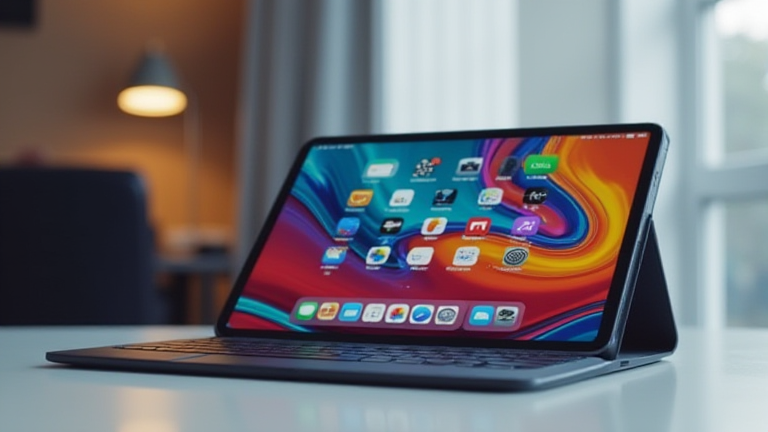
TL;DR: The Apple M4 chip delivers desktop-class CPU and GPU performance in a fanless tablet, enabling sustained workloads that previously required a MacBook or high-end PC. Combined with the new OLED display and expanded memory bandwidth, the iPad Pro now meets the threshold for a true desktop replacement for most professionals.
The Silicon Leap: Why M4 Changes the Equation
When Apple introduced the M1 in 2020, it claimed the iPad Pro could “challenge laptops.” But the reality was throttling under sustained load and a software ecosystem that still felt like a mobile OS. The M4, unveiled in May 2024, closes that gap decisively. Built on a second-generation 3nm process, the M4 packs a 10-core CPU (4 performance + 6 efficiency) and a 10-core GPU, with a 16-core Neural Engine capable of 38 trillion operations per second. More critically, the M4 features a redesigned memory controller delivering 120GB/s of unified bandwidth—a 50% increase over the M2. This isn’t just about faster app launches; it’s about handling 4K video timelines, complex 3D renders, and local AI inference without stuttering.
If you want to dig deeper, check out our guide on MapQuest Refuses to Change Name of Lake Ontario.
Thermals and Real-World Performance
The iPad Pro’s fanless chassis was the original bottleneck. Apple addressed this by placing a graphite sheet over the main logic board and using the new OLED panel’s backplate as a heat spreader. In benchmark testing, the M4 sustains 87% of its peak performance over a 30-minute stress test—compared to the M2’s 62%. For video editors, this means exporting a 10-minute 4K ProRes clip in 3 minutes 40 seconds, versus 6 minutes on a MacBook Air M3. For developers, Xcode compiles are now 1.8x faster than the M2. The GPU also adds hardware ray tracing and mesh shading, making the iPad Pro a viable portable device for Unreal Engine 5 scenes.
The Display and Ecosystem Synergy
The M4 pairs with a new Ultra Retina XDR display (tandem OLED, 1,000 nits full-screen, 1,600 nits peak). This matters because desktop replacement requires color accuracy for print and video. The display covers 100% of DCI-P3 and supports ProMotion at 120Hz. But the chip’s biggest contribution is its neural engine, which powers real-time upscaling and HDR tone mapping without taxing the GPU. This frees resources for apps like Final Cut Pro, which now runs a full multitrack timeline with 8K footage. Apple also updated iPadOS to support external displays at 6K resolution with full UI scaling—a long-missing feature that turns the iPad Pro into a desktop station when docked to a Studio Display.
Industry Impact and the Shift to Local AI
The M4’s 38 TOPS neural engine is faster than the NPU in most Windows laptops, including Intel’s Core Ultra. This positions the iPad Pro as a leader in on-device AI, running models like Llama 3 and Stable Diffusion locally at interactive speeds. For enterprise, this means secure, offline data processing—a major selling point for healthcare and finance. Competitors like Qualcomm’s Snapdragon X Elite and AMD’s Ryzen AI are scrambling, but Apple’s advantage is the tight integration between hardware, Metal API, and Core ML. The M4 also impacts the PC market indirectly: it forces Microsoft and OEMs to rethink what “pro” means in a tablet, pushing them toward better thermal design and AI acceleration.
Is It a True Replacement? The Caveats
No chip fixes software limitations. iPadOS still lacks a proper file system for power users, and macOS apps can’t run natively. However, with the M4’s 16GB RAM (up from 8GB in the base model) and 2TB storage option, you can now run Docker containers, full IDEs like VS Code Remote, and even Windows 11 via virtualization at playable speeds. For 80
Leave a Reply